
- 3-Axis
- Used in Router CNC machines
- Feature: Automatic Tool Change

Videos
DESCRIPTION
The XYZ Router – TC interface serves as a user interface between the operator and advanced software for a three-axis CNC machine, featuring capabilities such as automatic tool change, support for various types of linear and rotary parking systems, and digital output control during G-code execution via M-Code. Complementary features like the ability to connect an XBOX controller and keyboard as remote controllers, automatic park position adjustment, and the definition of up to 6 reference points for work start positions make machine operation easy and precise for operators. All inputs and outputs are pre-configured by default, so no additional programming is required. The interface can also be customized visually to fit the industrial needs and branding of manufacturing companies.
Introduction
One-line value prop: Production-grade routing for wood, stone, plastics, composites, and light metals—ATC, RTCP, multi-spindle support, 3D toolpath view, and Floor depth limits for safe, accurate parts
Who uses it: Woodworking & cabinetry · sign & exhibit · plastics/composites · mold making · stone processing · dental/CAM labs.
Works with: Gantry routers from 3 to 6 axes (XYZ + A/B/C), single or multi-spindle heads, and linear / rotary / jack ATC systems.
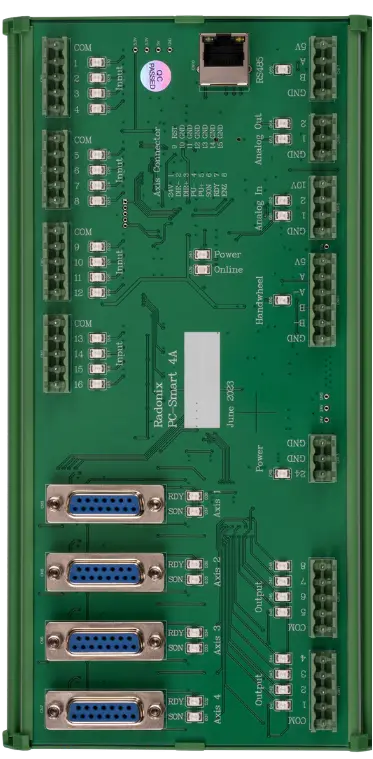
Compatible controllers: PC-SMART 4A / PC-SMART 3AS / PC-PRO LAN 4A
Supported files: DXF and standard G-code
Machine & Kinematics
3–6 axis contouring (XYZ + A/B/C) with homing, soft limits, and work offsets (G54–G59).
RTCP (Rotation Tool Center Point): keeps the tool tip on the programmed path while A/B/C rotate—no reposting when you change pivots or tool lengths.
Supports multi-spindle heads (sync or sequential) with per-spindle RPM and offset management.
Integrated Automatic Tool Changer: linear, carousel/rotary, and jack types with safe clamp/unclamp sequencing.
Control & I/O
-
Spindle ON/OFF and commanded RPM (VFD), vacuum zones, dust/mist/air, clamps/fixtures, beacons, guards & Emergency.
-
Tool length setter on Z for automatic referencing after each change; optional tool-break input.
-
Per-spindle controls (ON/OFF, RPM, selection), ATC interlocks, magazine position sensors.
-
Operator aids: Feed/Speed overrides, Pause/Resume, single-step, safe restart from last block.
Software & Workflow
- Import DXF/G-code, preview toolpaths, and apply kerf/offset automatically.
- Lead-in/lead-out styles (arc, radial, tangential), pierce dwell, and height retract macros.
- Corner smoothing and arc handling to maintain cut speed and edge quality.
- Priority ordering (inner → outer) and automatic pause points for clamp moves or checks.
- Job Queue & Repeat for batches; simulation / dry-run before cutting.
- Run reports: cycle time, cut length, pierces, pauses/restarts; operator notes saved with the job.
Key Capabilities
(at a glance)
Key Capabilities(at a glance)
-
Up to 6 simultaneous axes (XYZ + A/B/C) across wood/stone/milling/mold/dental
-
RTCP to maintain tool-tip accuracy during 5-axis motion
-
Multi-spindle head control (sync/sequential) with per-spindle offsets & RPM
-
ATC for linear, rotary/carousel, and jack magazines with full interlocks
-
Automatic Z tool-offset sensing (tool setter) & wear compensation
-
3D toolpath & rotary visualization for verification before cutting
-
Floor depth restriction, safe Pause/Resume, restart from line
- Surface Scan capability for automatic Z-axis compensation according to the irregularities of the workpiece surface.
- Ability to modify the executable file (Rotate, Scale, Flip, Fit Dimension).
- Real-time reference displacement (Displace Reference) during job execution.
- Independent homing function for Gantry motors, enabling automatic orthogonality (X,Y) or alignment (Z) calibration.
- Dual-purpose sensor support for using a single sensor as both Home and Limit switch simultaneously.Power-loss recovery (Restart from line): Safely resumes from the last executed G-code line with automatic re-arm of spindle, vacuum, and safe Z re-entry.
Standard Workflow
Home all axes; set work offset (G54); run tool-setter cycle on the current tool.
Open DXF/G-code; map layers to tools/strategies; confirm step-downs, comps, and Floor limit.
Run. The interface performs ATC, probes tool length, applies RTCP (if enabled), and executes the job with safe retracts.
Use Feed/Speed overrides and Pause/Resume as needed; restart safely from the last block.
Review and save the run report.
Typical Specifications
| Area | Spec |
|---|---|
| Axes | XYZ (base), optional A/B/C (up to 6 simultaneous) |
| Tool Change | Automatic: linear, rotary/carousel, jack |
| Probing | Z tool-setter (tool length & wear); optional tool-break |
| Spindle/VFD | On/Off + RPM command; warm-up & interlocks |
| Files | DXF, G-code (layer→tool mapping) |
| Strategies | Profile, pocket, drill/peck, ramp/helix, tabs/onion-skin, rest-machining |
| Compensation | Tool dia comp, lead-in/out, corner smoothing |
| Visualization | 3D toolpath, rotary axes display (A/B/C) |
| Safety | Guards/doors, vacuum OK, clamps/fixtures, E-stop |
| Limits | Floor (max depth), soft limits, safe retracts |
| Reporting | Time, path length, tools used, pauses/alarms, notes |
Key Features of Radonix CNC Software
🔹 Six-axis router support:
Coordinate XYZ + up to three rotary axes (A/B/C) across wood, stone, milling, mold-making, and dental machines—up to 6 simultaneous axes.
🔹 RTCP (Rotation Tool Center Point):
Keeps the tool tip exactly on the programmed path during 5-axis rotations—no re-posting when you change head lengths or pivots.
🔹Multi-spindle heads
Run spindles synchronously or sequentially with per-spindle ON/OFF, RPM, offsets, and tool numbers.
🔹 Automatic tool changing:
Works with linear, rotary/carousel, and jack magazines—full clamp/unclamp sequencing, interlocks, tool table, and safe recovery.
🔹 Automatic Z tool offset & referencing:
Touch-setter cycles capture tool length (and optional diameter) for accurate depths and wear compensation after each change.
🔹 3D toolpath & rotary visualization:
Preview the job in true 3D with live A/B/C angles to verify reach, orientation, and motion before cutting.
🔹 Floor (depth) limit:
Enforces a maximum Z penetration so the tool never cuts past the programmed floor—protects the table, fixtures, and laminated stacks.