IoT for CNC Machines: Benefits, Use Cases & How to Get Started
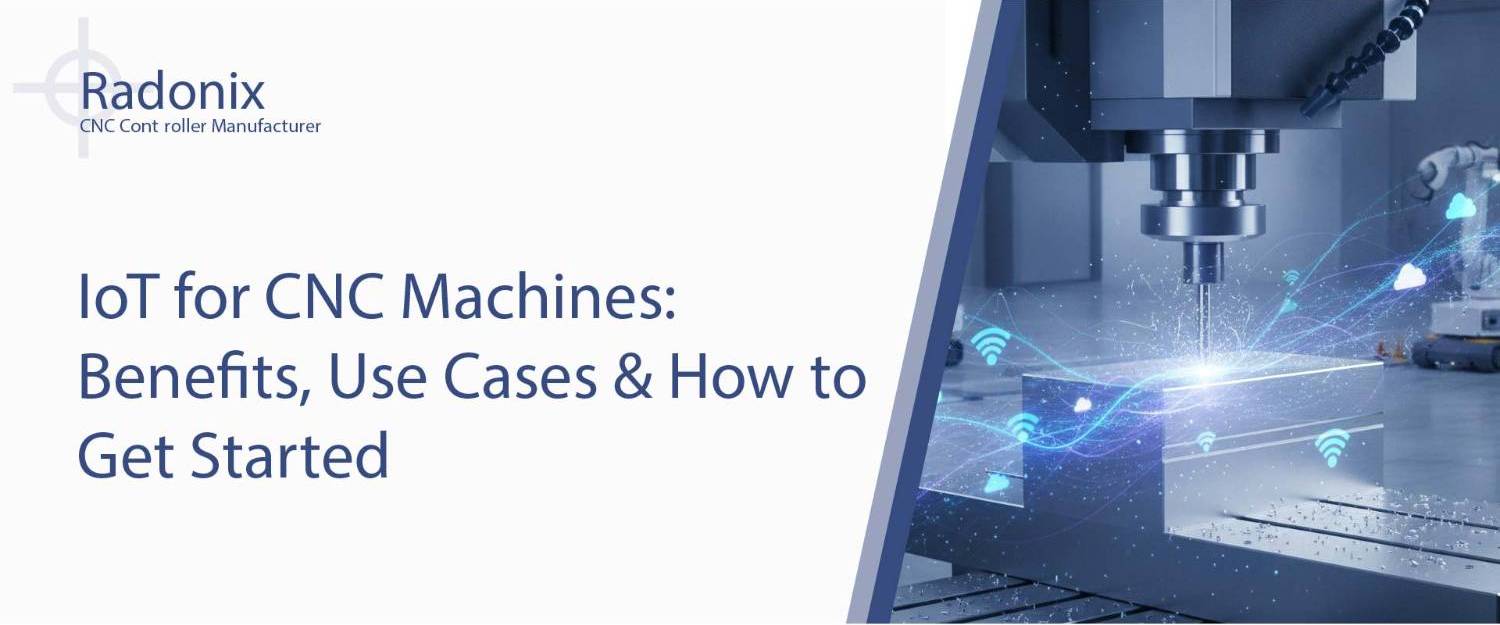
IoT for CNC is transforming machine shops from reactive maintenance and guesswork into predictive, data-driven operations. By connecting CNC machines to the internet and collecting real-time data from sensors, controllers, and drives, manufacturers gain visibility into uptime, tool wear, cycle efficiency, and quality trends they never had before. If you’re running CNC equipment and wondering whether IoT makes sense for your shop, this overview explains what it is, why it matters, and how to begin.
What does IoT mean for CNC manufacturing?
IoT — the Internet of Things — means connecting physical devices to a network so they can send and receive data. In a CNC context, iot for cnc means equipping machine tools with sensors, network connectivity, and software that continuously report machine state, performance metrics, and alarms to a central dashboard or cloud platform.
Traditional CNC machines operate in isolation. An operator knows the machine is running only if they’re standing next to it. Downtime, tool breakage, or a drift in dimensional accuracy often goes unnoticed until parts fail inspection or a machine stops completely. IoT changes that by making machines visible and measurable from anywhere.
Core components of CNC IoT include:
- Sensors: measure spindle load, vibration, temperature, tool position, cycle time, power consumption.
- Connectivity: Ethernet, Wi-Fi, industrial protocols (Modbus, OPC UA, MQTT) send data out.
- Edge devices or gateways: collect and pre-process data from legacy machines that lack built-in networking.
- Cloud or on-premises software: dashboards, analytics, and alerting platforms that turn raw data into actionable insights.
The goal is not connectivity for its own sake. The goal is better decisions: knowing which machines are idle, predicting when a spindle bearing will fail, optimizing cycle times, and reducing scrap before it accumulates.
Key benefits: uptime, predictive maintenance, and data visibility
Connecting CNC machines to an IoT system delivers measurable improvements across operations. The most significant benefits center on visibility, maintenance strategy, and efficiency.
Increased uptime and availability. Real-time monitoring shows which machines are running, idle, or in alarm. If a machine stops unexpectedly, operators and managers are notified immediately rather than discovering the issue hours later. Many shops report 10–20% gains in effective machine time simply from faster response to downtime.
Predictive maintenance instead of reactive repair. IoT sensors track leading indicators of failure — rising spindle temperature, abnormal vibration, increased motor current — and trigger alerts before a component fails catastrophically. This shifts maintenance from reactive (fix it when it breaks) to predictive (replace the bearing during planned downtime before it seizes). Predictive maintenance reduces unplanned downtime, extends component life, and lowers repair costs.
Operational visibility and KPIs. IoT dashboards aggregate data across multiple machines, shifts, and facilities. Managers can see:
- Overall Equipment Effectiveness (OEE) in real time.
- Cycle time trends and throughput by part program.
- Downtime reasons categorized (changeover, alarm, tool breakage, waiting for operator).
- Energy consumption per part or per shift.
This visibility exposes bottlenecks, identifies underutilized machines, and supports data-backed decisions about capacity planning and process improvements.
Quality consistency. By monitoring process parameters — spindle speed, feed rates, temperatures — and correlating them with inspection results, IoT helps identify when a process drifts out of spec. Early detection prevents scrap runs.
Remote monitoring and management. For shops with multiple locations or machines running lights-out, IoT enables remote oversight. Production managers and engineers can monitor machines from home or another facility and respond to issues without being on the shop floor.
For a breakdown of the technical architecture and data flows that enable these benefits, read the step-by-step guide for IoT applications in CNC systems.
Real-world use cases: IoT in a CNC machine shop
IoT for CNC machines is already deployed in job shops, contract manufacturers, and OEM production lines. Here are practical examples of how shops use it.
Case 1: Spindle health monitoring. A shop running high-speed milling operations installed vibration and temperature sensors on spindle housings. The IoT platform learned baseline vibration patterns and flagged a gradual increase on one machine. Inspection revealed a failing bearing. The shop replaced it during a scheduled weekend, avoiding a mid-shift spindle failure that would have scrapped parts and halted production for days.
Case 2: Tool life optimization. A contract manufacturer tracked spindle load and cycle count per tool. When load increased or cycle time crept up, the system flagged the tool for inspection or replacement. This prevented sudden tool breakage, reduced scrap, and extended tool life by replacing inserts at the optimal point rather than prematurely or too late.
Case 3: OEE improvement across a 15-machine shop. A mid-sized shop connected all its CNC mills and lathes to an IoT platform. Dashboard analysis revealed that two machines spent 30% of their time idle waiting for operators during setup. The shop reorganized workflow and cross-trained operators, increasing effective runtime and throughput without buying new equipment.
Case 4: Remote monitoring for lights-out machining. A shop running unattended night shifts used IoT alerts to notify supervisors of any machine alarm or abnormal condition. If a machine stopped, the supervisor could view the status remotely and decide whether to send someone in or wait until morning. This reduced wasted overnight hours and gave confidence in unattended operation.
Case 5: Energy and cost tracking. A facility monitoring power consumption per machine identified one older lathe drawing significantly more current than comparable units. Investigation found a worn motor and inefficient hydraulics. Replacing them cut energy use by 25% on that machine and paid for itself in months.
These examples show iot for cnc solving real production problems, not just generating data for data’s sake.
How CNC IoT data collection works: sensors, protocols, dashboards
Understanding how data moves from a CNC machine to a dashboard helps demystify IoT implementation.
Data sources. CNC IoT systems collect data from:
- The CNC controller itself (program running, axis positions, feed override, alarms, cycle count).
- Motor drives (load, current, faults).
- Sensors added to the machine (vibration accelerometers, thermocouples, current clamps, proximity switches).
- Auxiliary equipment (coolant level, air pressure, part counters).
Communication protocols. Data is transmitted using industrial and IT protocols:
- Modbus TCP/RTU: widely supported by PLCs, drives, and controllers; good for polling numeric data.
- OPC UA: modern, secure, and standardized for industrial automation; supports complex data models.
- MQTT: lightweight, publish-subscribe protocol popular in IoT; efficient for sending time-series data to cloud platforms.
- Ethernet/IP and PROFINET: common in factory automation networks.
Controllers and sensors may speak different protocols, so a gateway or edge device often translates and aggregates them.
Edge devices and gateways. Legacy CNC machines rarely have native IoT connectivity. An edge gateway sits on the shop network, polls or listens to machine data, pre-processes it (filtering, aggregating, calculating KPIs), and forwards it to a central system. This keeps network traffic manageable and allows some analytics at the edge even if cloud connectivity is lost.
Dashboards and analytics platforms. Data lands in a software platform — cloud-based (AWS IoT, Azure IoT, Google Cloud IoT) or on-premises (local server running Grafana, InfluxDB, or a commercial MES/IoT package). The platform stores time-series data, calculates OEE and other metrics, triggers alerts based on rules or machine learning models, and visualizes everything in dashboards accessible from desktops, tablets, or phones.
IIoT vs. IoT: which applies to CNC environments?
You’ll see both IoT and IIoT (Industrial Internet of Things) used interchangeably when discussing iot for cnc, but there’s a distinction worth understanding.
IoT is the broad umbrella: any device connected to the internet and exchanging data. It includes consumer gadgets (smart home devices, wearables) and industrial equipment alike.
IIoT is IoT applied specifically to industrial and manufacturing environments. IIoT emphasizes ruggedness, reliability, real-time data, determinism, and integration with existing factory systems (PLCs, SCADA, MES). Security, uptime, and interoperability matter more in IIoT than in consumer IoT.
In practice, when discussing CNC machine connectivity, people usually mean IIoT even if they say IoT. Key IIoT characteristics relevant to CNC:
- Harsh environment tolerance: sensors and hardware must survive metal chips, coolant spray, vibration, temperature swings.
- Deterministic communication: time-sensitive data (real-time position, alarms) needs low latency and guaranteed delivery.
- Industrial protocols: support for Modbus, OPC UA, EtherCAT, not just HTTP/REST.
- Security: factory networks can’t be as open as consumer IoT; access control, encryption, and segmentation are critical.
- Integration with legacy equipment: many CNC machines are decades old; IIoT solutions must work with equipment that predates the internet.
For CNC shops, the term you use matters less than the requirements you specify: reliable data collection from industrial equipment, secure communication, and actionable insights. That’s IIoT.
Challenges of implementing IoT in legacy CNC machines
Most CNC machines in operation today were built before IoT was a consideration. Connecting them introduces specific challenges.
No native connectivity. Older controllers lack Ethernet ports, APIs, or any way to export data. Retrofitting connectivity requires adding external sensors, tapping into controller I/O or display signals, or installing an edge gateway that interprets proprietary protocols. This isn’t always plug-and-play.
Proprietary protocols. Even controllers with network ports may use closed, undocumented communication protocols. Reading data might require reverse engineering, vendor-specific adapters, or third-party middleware.
Lack of sensor mounting points. Machines not designed for instrumentation may lack convenient places to mount accelerometers, temperature sensors, or current clamps without interfering with operation or safety.
Network infrastructure. Older shops may lack the wired or wireless network infrastructure to reliably move data from every machine to a central server. Adding switches, running cable, and ensuring coverage takes time and budget.
Data overload without context. Collecting data is easy; making sense of it is harder. Without clear KPIs and a plan for acting on the data, shops drown in dashboards that nobody looks at. Successful IoT projects start with specific questions: What problem are we solving? What metric tells us it’s improving?
Security concerns. Connecting shop-floor equipment to a network — especially the internet — introduces cybersecurity risk. Machines that were air-gapped are now potential entry points. Implementing firewalls, VLANs, access controls, and secure protocols is non-negotiable but adds complexity.
Cost and ROI uncertainty. IoT infrastructure (sensors, gateways, software licenses, installation labor) costs money. Shops want confidence the investment will pay back in reduced downtime or higher throughput. Starting with a pilot — one or two machines — helps prove ROI before scaling.
These challenges are real but solvable. Thousands of shops have successfully implemented CNC IoT. The key is a methodical approach: assess current state, define objectives, pilot on one machine, measure results, then scale.
How Radonix controllers support IoT and Industry 4.0 integration
Radonix CNC controllers are designed with modern connectivity in mind, making iot for cnc integration more straightforward than retrofitting older systems.
Radonix controllers offer network connectivity and open communication protocols that simplify data collection and monitoring. Features relevant to IoT and Industry 4.0 include:
- Ethernet connectivity: built-in network interfaces allow controllers to communicate over standard factory networks without additional hardware.
- Support for industrial protocols: compatibility with Modbus, OPC UA, and MQTT enables integration with MES, SCADA, and cloud IoT platforms.
- Real-time data access: controllers expose machine state, axis positions, program status, alarms, and I/O states for external systems to read and log.
- API and logging capabilities: structured data output makes it easier for analytics platforms to collect, parse, and store CNC operational data.
- Expandable I/O: additional sensor inputs can be wired directly to the controller, consolidating data collection and reducing the need for separate sensor gateways.
For shops building new machines or upgrading older equipment, selecting a controller with native IoT support reduces integration complexity, lowers cost, and accelerates time to insight. Radonix controllers are built to participate in connected, data-driven manufacturing environments from day one.
Planning an IoT project for your CNC machines? Explore how Radonix controllers fit into modern, connected shop-floor architectures.
Frequently Asked Questions
What is IoT for CNC machines?
IoT for CNC means connecting machine tools to a network and using sensors, controllers, and software to collect real-time data on machine status, performance, and health. The data is used for monitoring, predictive maintenance, and operational improvements.
Do I need to replace my old CNC machines to use IoT?
No. Legacy machines can be retrofitted with external sensors and edge gateways that collect data without modifying the controller. However, newer controllers with built-in IoT support simplify the process.
What’s the difference between IoT and IIoT in manufacturing?
IIoT (Industrial IoT) is IoT applied to industrial environments. It emphasizes ruggedized hardware, industrial communication protocols, real-time data, security, and integration with factory systems. For CNC, IIoT is the more accurate term.
How much does it cost to add IoT to a CNC machine shop?
Costs vary widely based on the number of machines, existing infrastructure, and chosen platform. A single-machine pilot with basic sensors and a cloud dashboard can start at a few thousand dollars. Enterprise deployments with full MES integration cost significantly more. ROI typically comes from reduced downtime and improved throughput.
Conclusion
IoT for CNC machines is no longer experimental — it’s a proven path to higher uptime, lower maintenance costs, and data-driven decision-making. Whether you’re monitoring a single high-value machine or connecting an entire shop floor, the fundamentals are the same: sensors capture data, protocols move it, software makes it actionable. The challenges of legacy equipment, network infrastructure, and proving ROI are real but manageable with a clear plan and a pilot-first approach. For a complete technical walkthrough — sensor selection, protocol configuration, data architecture, and platform integration. Ready to bring your CNC machines into Industry 4.0? Start with one machine, measure the results, and scale from there.