
High-Precision Part Production with CNC Lathe Systems
Author: Radonix R&D Team
High-precision part production with CNC lathe systems defines the backbone of modern manufacturing. From micron-level tolerance control to repeatable large-scale output, CNC lathes combine mechanical rigidity with advanced motion control technology to deliver consistent, scalable, and high-quality machining results.
In real industrial environments, precision is not only about achieving theoretical dimensional accuracy, it is about maintaining that accuracy across thousands of parts, multiple shifts, and changing thermal conditions. CNC lathe systems ensure stability by synchronizing spindle dynamics with X and Z axis motion in real time. This deterministic coordination allows manufacturers to maintain dimensional integrity even during long production cycles and high-speed machining operations.
Industries such as automotive, aerospace, medical devices, energy, and defense rely on CNC lathe machining for components that demand strict dimensional accuracy and flawless surface finishes. Through intelligent motion control systems, servo-driven positioning, and closed-loop feedback monitoring, manufacturers achieve faster cycle times, stable repeatability, reduced scrap rates, and improved operational reliability.
How CNC Lathe Systems Operate
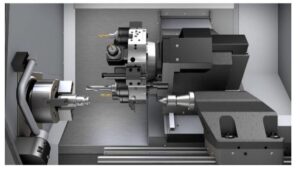
A CNC lathe operates by rotating the workpiece while a precision-controlled cutting tool removes material according to programmed instructions. The motion controller synchronizes spindle rotation with X and Z axis movement to ensure accurate contouring, threading, drilling, grooving, and finishing.
Unlike manual systems, CNC lathe platforms rely on real-time interpolation algorithms that calculate tool paths continuously. This enables smooth transitions between linear and circular movements while preserving surface quality.
Compared to manual lathes, CNC lathe systems provide:
- Greater geometric flexibility for complex part profiles
- Deterministic motion control that eliminates operator variation
- Continuous automated production with minimal setup changes
- Stable spindle-to-axis synchronization during threading cycles
This controlled coordination between axes and spindle ensures repeatable accuracy across production cycles and prevents dimensional drift during high-speed operations.
Core Advantages of CNC Lathe Machining
Precision and Repeatability
CNC lathe systems maintain identical dimensional output across large production batches. Motion controllers continuously regulate feed rate, spindle speed, and axis positioning to prevent deviation. Feedback from encoders allows micro-adjustments during machining, maintaining consistent diameter, roundness, and depth control.
Production Efficiency
Automated tool paths reduce machining time while maintaining surface quality. Advanced interpolation ensures smooth transitions between contours, minimizing mechanical shock and tool wear. Optimized acceleration and deceleration curves also reduce idle time between cutting operations.
Consistent Quality Control
Sensor-driven monitoring detects tool wear, vibration, and load variation, enabling corrective adjustments during operation. This reduces scrap rates, extends tool life, and improves long-run stability in demanding industrial applications.
Material Versatility in CNC Lathe Production
CNC lathes machine a broad spectrum of materials including:
- Carbon and alloy steels
- Aluminum alloys
- Titanium
- Stainless steel
- Engineering plastics and composites
Each material presents different cutting characteristics. Modern motion control systems optimize feed rate, cutting speed, torque output, and depth automatically based on programmed parameters. This adaptability ensures stable surface finish and dimensional consistency across diverse materials while preventing overheating or premature tool degradation.
Multi-Operation Capability in a Single Setup
Modern CNC lathe systems integrate multiple operations into one controlled workflow, including:
- Turning
- Drilling
- Threading
- Grooving
- Surface finishing
By maintaining a unified coordinate system, the CNC lathe eliminates repositioning errors and reduces manual intervention. Completing multiple operations in a single setup improves concentricity and reduces cumulative tolerance variation between processes. This significantly enhances production throughput and dimensional integrity.
Maintaining Micron-Level Tolerances
High-precision part production depends on stable tolerance control. CNC lathe systems achieve this through:
- Real-time spindle-axis synchronization
- Backlash compensation
- Thermal drift monitoring
- Tool wear adjustment
- Smooth acceleration and deceleration profiles
Thermal expansion, mechanical backlash, and spindle load variation can all influence dimensional accuracy. Advanced motion control logic compensates for these factors dynamically, preserving tolerance even during extended production runs. Such motion stability is critical in engine components, turbine shafts, medical implants, hydraulic fittings, and other high-load mechanical assemblies where even minimal deviation affects performance and safety.
CNC Lathe Systems in Rapid Prototyping
CNC lathe technology accelerates prototype development by converting CAD designs into functional parts with minimal delay. Engineers can test dimensional accuracy, fit, and mechanical behavior quickly before committing to full-scale production.
Benefits include:
- Fast iteration cycles
- Dimensional validation before mass production
- Reduced tooling costs
- Direct transition from prototype to scaled production
This rapid validation process shortens development timelines, supports innovation-driven industries, and reduces time-to-market for precision components.
Role of CNC Lathe Systems in Industrial Production
CNC lathes support both high-volume manufacturing and customized production. Their programmable architecture enables seamless scaling from single components to full production runs without compromising dimensional stability.
Key production benefits include:
- Stable repeatability across thousands of parts
- Reduced downtime through automated sequences
- Optimized spindle performance under variable loads
- Improved energy efficiency through controlled motion profiles
By maintaining consistent machining parameters and minimizing manual intervention, CNC lathe systems provide predictable output and measurable operational efficiency.
Automation and Smart Factory Integration
Advanced CNC lathe systems integrate into digital production environments using Ethernet-based communication and industrial motion control platforms. Real-time data exchange enables centralized monitoring and performance analysis across multiple machines.
Automation advantages include:
- Predictive maintenance through performance monitoring
- Remote diagnostics and troubleshooting
- Lights-out manufacturing capability
- Data-driven process optimization
When integrated into smart factory ecosystems, CNC lathe systems contribute to continuous improvement initiatives, enhanced uptime, and long-term production sustainability.
Conclusion — Precision Motion at the Core of Production
High-precision part production with CNC lathe systems relies on stable motion control, synchronized spindle coordination, and deterministic machining logic. These technologies ensure accuracy, repeatability, and production scalability across demanding industrial sectors.
Radonix integrates advanced motion controller technology into CNC lathe solutions, enabling manufacturers to achieve superior dimensional accuracy, operational reliability, and long-term performance stability.
For high-precision part production using CNC lathe systems, contact Radonix or use the chatbot in the bottom right corner to discuss your application requirements.
Contact Us:
- E-Mail: info@radonix.com
- Phone: +90 (553) 920 5500